
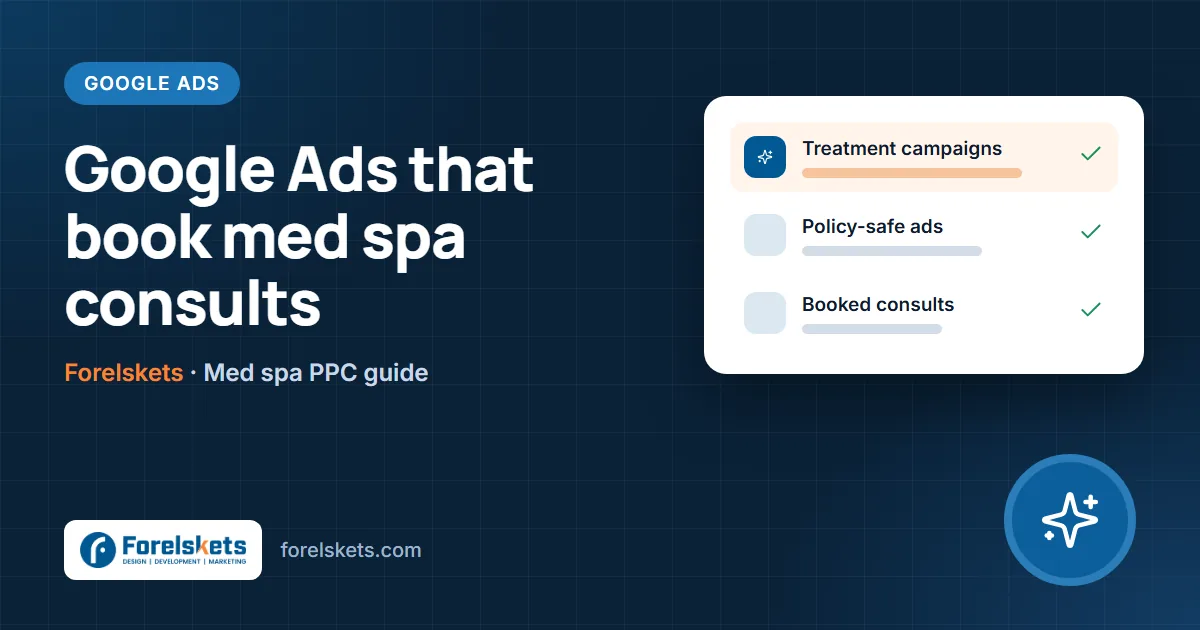
Google Ads for med spas works best when each campaign targets one high-value treatment, sends clicks to a matching landing page, respects Google’s healthcare advertising rules, and tracks every call and booking. Done this way, search ads reach people who are actively looking for injectables, laser treatments or body contouring near them — the highest-intent prospects a med spa can get.
This guide covers campaign structure, keywords, ad policy, landing pages, budgets and tracking for med spas in the USA, Canada and Australia.
Why search ads work for med spas
Most aesthetic treatments start with research: "laser hair removal near me", "lip filler cost", "best med spa in Austin". Someone typing that is closer to booking than someone scrolling social media. Google Ads lets you appear at that moment, in your area, during your opening hours, and measure exactly what each click produced.
Understand the ad policies first
Medical aesthetics sits in a regulated category. Google restricts advertising for prescription drugs and some medical services, and the rules differ by country. Read Google’s healthcare and medicines policy before you write a single ad. In practice, many med spas:
- Advertise the treatment area or outcome ("wrinkle treatment", "injectables consultation") rather than prescription brand names in ad text.
- Avoid before-and-after claims that promise specific results.
- Make sure landing pages name the licensed medical provider and include clear disclaimers.
- Follow local rules for medical advertising and patient testimonials.
Disapproved ads and suspended accounts cost far more than a careful setup.
Campaign structure that works
Separate campaigns by treatment so budgets and messages match demand:
| Campaign | Example keywords | Landing page focus |
|---|---|---|
| Injectables | wrinkle treatment near me, lip filler consultation, injectables med spa | Provider credentials, pricing guidance, consultation booking |
| Laser hair removal | laser hair removal near me, laser hair removal cost, packages | Packages, session counts, skin-type suitability |
| Skin treatments | microneedling, chemical peel, acne scar treatment | Treatment explanation, downtime, results timeline |
| Body contouring | body contouring near me, non-surgical fat reduction | Consultation, financing, candidate checklist |
| Brand | your med spa name | Homepage or booking page |
Keep a brand campaign running even if you rank first organically — it protects your name from competitors and is usually inexpensive.
Keyword strategy
- Lead with high-intent phrases: "near me", "cost", "price", "consultation", "best … in [city]".
- Use phrase and exact match for core treatments; test broad match only with good conversion data.
- Add negative keywords early: jobs, training, courses, certification, DIY, at home, free, cheap (if you are premium).
- Review search terms weekly in the first months to remove irrelevant traffic.
Targeting and scheduling
- Radius targeting around your location based on how far clients actually travel — often 10 to 25 miles in cities.
- "Presence" targeting so you reach people in your area, not people merely interested in it.
- Ad schedule aligned with when your team can answer calls, with call-only extensions turned off after hours.
- Device adjustments — mobile usually dominates; make sure the mobile booking experience is excellent.
Landing pages that turn clicks into consultations
The landing page decides whether a click becomes a booking. Each treatment page should include:
- A headline that matches the search ("Laser Hair Removal in Scottsdale").
- Who performs the treatment and their credentials.
- Pricing guidance, packages or financing options.
- Real reviews and, where allowed, before-and-after photos with consent.
- What to expect: number of sessions, downtime, results timeline.
- One clear action: book a consultation, with phone and online booking.
Fast loading on mobile is essential. A slow page wastes every dollar spent on clicks. Our website team builds treatment pages designed for ads.
Budgets and what to measure
Click costs vary by city and treatment. Rather than copying someone else’s budget, work backwards:
- Estimate the value of a new client over a year (many med spa clients return for repeat treatments).
- Decide what you can afford to pay for a booked consultation.
- Start with enough budget to collect meaningful data in 60 to 90 days.
Measure cost per booked consultation and revenue per campaign, not just clicks. Set up conversion tracking for calls, forms and online bookings using Google Ads conversion tracking, and connect your booking software where possible.
Writing ads that get clicks and stay compliant
Strong med spa ads are specific, local and honest. A good responsive search ad usually combines:
- The treatment and the place: "Laser Hair Removal in Scottsdale".
- A credibility point: "Treatments by Licensed Nurse Injectors" or "Medical Director On Site".
- An offer or next step: "Free Consultation", "Package Pricing", "Financing Available".
- A reason to choose you: reviews, years open, technology used.
Avoid guaranteed results ("look 10 years younger"), unverifiable superlatives and claims about medical outcomes. Use sitelinks for each treatment, call extensions during staffed hours, and location extensions linked to your Google Business Profile.
Seasonality and promotions
Demand for aesthetic treatments changes through the year. Laser hair removal and skin resurfacing are often booked in cooler months, body treatments before summer, and injectables before holidays and events. Plan budgets and landing-page offers a few weeks ahead of each peak, and lower bids in quiet periods rather than switching campaigns off completely, so you keep learning data.
Meta ads and retargeting alongside search
Search ads capture demand that already exists. Meta (Facebook and Instagram) ads create demand and bring back people who visited but did not book. A simple combined setup works well for most clinics:
| Channel | Job | Example |
|---|---|---|
| Google Search | Capture people searching now | "lip filler near me" → filler consultation page |
| Meta prospecting | Introduce treatments to local audiences | Short video explaining a treatment and who it suits |
| Retargeting | Bring back visitors who did not book | Reminder of the consultation offer and reviews |
| Email and SMS | Rebook existing clients | Treatment-interval reminders and seasonal offers |
Keep the offer and message consistent across channels so the landing page feels familiar when people arrive.
A 90-day launch plan
- Weeks 1–2: policy check, conversion tracking, treatment landing pages, brand campaign.
- Weeks 3–6: launch two or three treatment campaigns with phrase and exact match; review search terms twice a week.
- Weeks 7–10: shift budget towards the treatments with the lowest cost per booked consultation; test new ad copy and offers.
- Weeks 11–13: add retargeting, consider Smart Bidding once conversion data is reliable, and review attended consultations and revenue.
Common mistakes med spas make with Google Ads
- Sending all ads to the homepage.
- Ignoring ad policy until the account is suspended.
- Running Performance Max without good conversion data, which can spend on low-quality placements.
- Not answering calls quickly — leads go cold within minutes.
- Measuring success by clicks instead of booked, attended consultations.
What to track each month
| Metric | Why it matters |
|---|---|
| Cost per booked consultation | The main number for judging each treatment campaign |
| Consultation show rate | Low show rates point to follow-up or targeting problems |
| Consultation-to-treatment rate | Shows whether ads attract the right prospects and whether the offer works |
| Revenue per campaign | Lets you move budget to the treatments that earn the most |
| Search impression share | Tells you whether budget or ad rank is limiting growth |
Connect your booking or practice-management software to your tracking where possible, so attended appointments and revenue — not just form fills — are visible.
Speed to lead: the hidden conversion factor
Many med spa enquiries are made in the evening or on weekends, often by people comparing several clinics. The clinic that replies first, clearly and warmly, usually wins the booking. Set up instant email and text confirmations, offer online booking for consultations, and make sure missed calls are returned quickly — or answered automatically after hours.
Combine Google Ads with SEO, reviews and follow-up
Ads work best alongside a strong Google Business Profile, steady reviews and treatment pages that also rank organically. Fast follow-up matters too: an AI receptionist can answer after-hours calls and chats and book consultations so no paid lead is wasted.
Forelskets manages Google Ads for clinics and service businesses in the USA, Canada and Australia. If you want a second opinion on your account, ask for a free review through our PPC management page.
Frequently asked questions
Can med spas advertise Botox on Google Ads?
Prescription-drug terms are restricted in Google Ads, and policies vary by country. Many med spas advertise the treatment area and outcome (for example wrinkle treatment or injectables consultations) and keep brand-name drug terms out of ads. Check the current Google healthcare policy for your country before launching.
How much should a med spa spend on Google Ads?
It depends on your city, treatments and capacity. Start with a focused budget on two or three high-value treatments, measure cost per booked consultation for 60 to 90 days, then scale what works.
Which med spa treatments work best on Google Ads?
Treatments with clear search demand and good value per client usually perform best — injectables, laser hair removal, skin resurfacing, body contouring and medical weight-loss programs where allowed.
Should med spa ads go to the homepage?
No. Each treatment should have its own landing page with before-and-after photos where permitted, pricing guidance or financing, provider credentials, reviews and a simple booking form.
Are Meta ads or Google Ads better for med spas?
They do different jobs. Google Ads captures people already searching for a treatment; Meta ads create demand and retarget visitors. Most med spas get the best results using both with consistent offers.