
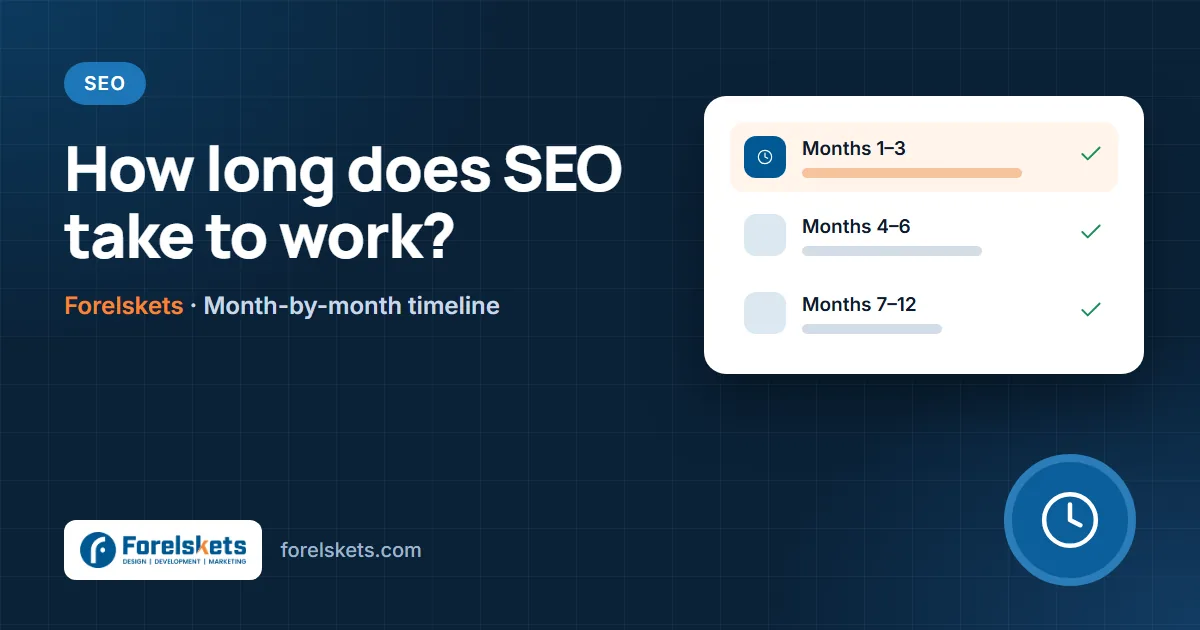
SEO usually takes three to six months to show clear progress and six to twelve months to deliver strong, reliable results. Local businesses targeting their own city often see movement sooner; new websites and competitive national keywords take longer. Google itself says that changes can take from several hours to several months to be reflected in search, depending on the page and the change (see Google’s SEO Starter Guide).
Below is a realistic month-by-month timeline, what affects the speed, and how to tell whether SEO is working before rankings jump.
Why SEO takes time
Search engines need to discover your pages, understand them, and trust them enough to rank them above pages that have been around for years. Each step depends on things that build gradually: crawling and indexing, content that matches search intent, links and mentions from other sites, reviews and user behaviour. You can speed these up, but you cannot skip them.
A realistic SEO timeline, month by month
| Period | What happens | What you should see |
|---|---|---|
| Month 1 | Audit, keyword research, tracking setup, technical fixes | A clear plan, fixed errors, Search Console and Analytics working |
| Months 2–3 | Service and location pages improved, Google Business Profile optimised, first new content | More pages indexed, impressions rising, first long-tail rankings |
| Months 4–6 | Content published regularly, internal linking, reviews and first links | Rankings on page one for some mid-competition terms, more organic leads |
| Months 7–12 | Authority building, content expansion, conversion improvements | Steady traffic growth, rankings for competitive terms, predictable lead flow |
| Year 2+ | Defend and expand rankings, new topics and locations | Compounding results and lower cost per lead than paid channels |
What makes SEO faster — or slower
1. How competitive your keywords are
"Plumber in a small town" and "personal injury lawyer in Los Angeles" are very different battles. Look at who ranks on page one today: national brands and directories mean a longer climb; small local businesses mean faster wins.
2. Your website’s history and authority
An older site with good links and reviews moves faster than a brand-new domain. Moving to a new domain or redesigning without redirects resets much of that progress — see our website development approach to protecting rankings during a rebuild.
3. Technical health
If pages are slow, blocked from indexing, duplicated or hard to crawl, content work will not pay off until these are fixed. That is why technical fixes come first.
4. Content quality and intent match
Pages that answer exactly what searchers want — prices, process, examples, FAQs — rank faster than thin pages written for keywords. Google’s guidance on helpful, people-first content is the best summary of what it rewards.
5. Consistency
Publishing and improving pages every month compounds. Stopping and starting resets momentum.
6. Local signals
For local businesses, a complete Google Business Profile, steady reviews and consistent business details across directories can move map-pack rankings sooner than organic rankings.
How to tell SEO is working before rankings jump
Rankings for your main keywords are a lagging indicator. Watch these leading indicators in Google Search Console and Analytics:
- Indexed pages — important pages are being indexed, errors are falling.
- Impressions — your site is appearing for more searches, even on page two or three.
- Long-tail rankings — longer, specific searches start ranking first.
- Click-through rate — better titles and descriptions earn more clicks at the same position.
- Calls and form leads from organic search — the number that matters most.
SEO timelines by type of business
| Business | Typical first wins | What usually takes longer |
|---|---|---|
| Local service business | Map pack, branded and "near me" searches | Competitive city-wide service terms |
| Professional services (law, accounting) | Specific practice-area questions | Broad "lawyer + city" terms |
| E-commerce store | Long-tail product and category terms | Head category terms against big retailers |
| SaaS / B2B | Comparison and problem-focused articles | Category-defining keywords |
What happens in the first 90 days
The first three months decide how fast the rest goes. A well-run programme usually covers the following, in roughly this order:
Weeks 1–2: measure and audit
- Connect Google Search Console, Bing Webmaster Tools and Google Analytics, and set up conversion tracking for calls and forms.
- Crawl the site for broken links, duplicate pages, missing titles, slow templates and indexing problems.
- Review competitors who rank for your most valuable searches and note what their pages do better.
Weeks 3–6: fix and focus
- Fix technical issues that block crawling or slow pages down.
- Map one main keyword theme to each important page so pages do not compete with each other.
- Rewrite titles, headings and introductions of key service pages to match search intent.
- Complete and correct your Google Business Profile and key directory listings.
Weeks 7–12: build
- Publish or expand the pages that are missing — services, locations, pricing and FAQs.
- Add internal links from strong pages to the pages you want to rank.
- Start a review-request routine and look for genuine link opportunities: partners, associations, local press.
By the end of this phase you should see more pages indexed, impressions rising and the first long-tail rankings — the foundation for the next six to nine months.
How much SEO effort is enough?
Timelines depend on effort as much as on competition. The table below shows how the same business might progress at different levels of monthly investment. It is illustrative, not a promise.
| Monthly effort | Typical activity | Likely pace |
|---|---|---|
| Light | Profile updates, occasional page fixes | Slow; protects what you have but rarely wins competitive terms |
| Moderate | Technical upkeep, two to four new or improved pages, reviews | Steady progress for local and mid-competition keywords |
| Intensive | Weekly content, digital PR, conversion work, multiple locations | Fastest growth, needed for competitive cities and national terms |
If your competitors publish and earn links every month while you do not, you will fall behind even with a technically perfect site. Match your effort to the market you want to win.
Signs your SEO strategy needs to change
- After four to six months, impressions and indexed pages are flat.
- Reports show rankings for keywords nobody would buy from.
- Traffic grows but leads do not — usually an intent or conversion problem.
- You cannot see what work was delivered each month.
Common mistakes that slow SEO down
- Changing URLs or launching a new site without 301 redirects.
- Publishing lots of thin pages instead of fewer genuinely useful ones.
- Buying links — this risks penalties and wastes time.
- Targeting only the most competitive keywords from day one.
- Not tracking leads, so no one can tell whether SEO pays off.
- Stopping after three months, just as results start to build.
Should you run Google Ads while SEO builds?
Often, yes. Google Ads can bring leads from the first week while SEO grows in the background. Ads also tell you which keywords convert, which helps decide what content to create. As organic leads increase, you can shift budget. Our PPC management and SEO services are planned together for exactly this reason.
Realistic examples
These scenarios show how timelines usually play out. They are illustrations of common patterns, not guarantees:
- A plumbing company in a mid-sized US city with an established website but an incomplete Google Business Profile often sees more calls from the map pack within the first two to three months once the profile, reviews and service pages are fixed. Ranking city-wide for "plumber [city]" can take six months or more.
- A new e-commerce store on a fresh domain typically starts with long-tail product searches. Category terms against large retailers usually take a year or longer and need content and links.
- A B2B software company publishing two strong comparison and problem-focused articles a month often sees impressions rise within the first quarter and demo requests from organic search building through months four to nine.
- A law firm in a major metro targeting personal injury terms faces some of the toughest competition online. Practice-area questions and neighbourhood terms usually come first; head terms take sustained effort over a year or more.
The common thread: specific, lower-competition searches move first and fund the patience needed for bigger keywords.
How to speed up results without cutting corners
- Fix technical blockers before writing new content.
- Improve the pages that already rank on page two — they are the closest to paying off.
- Target specific, long-tail questions where competition is lower.
- Build internal links from your strongest pages to the ones you want to rank.
- Ask every happy customer for a review, every week.
- Run Google Ads on your most valuable services while organic rankings grow.
What to expect from a good SEO partner
- A written plan with priorities for the first 90 days.
- Monthly reporting on traffic, rankings and leads — using your own Search Console and Analytics.
- Clear explanations of what was done and why.
- No ranking guarantees. No one controls Google’s results, and promises of "#1 in 30 days" are a red flag.
Want to know where your site stands today? Run our free website SEO checker or ask for a free audit, and we will show you the quick wins and a realistic timeline for your market.
Frequently asked questions
How long does SEO take for a new website?
New sites usually take longer because Google has little history or authority to judge them. Expect technical setup and first rankings for low-competition terms within a few months, and meaningful traffic growth more often in six to twelve months.
Can SEO work in one month?
Some fixes show quickly — for example, a page that was blocked from indexing, a Google Business Profile that was incomplete, or titles that did not match searches. But competitive rankings almost always take several months of steady work.
Why are my rankings going up and down?
Rankings fluctuate as Google re-crawls pages, tests results and rolls out updates. Judge progress over several weeks and look at clicks and leads in Search Console and Analytics, not daily positions.
Does local SEO work faster than national SEO?
Often yes. Improving a Google Business Profile, reviews and local pages can lift map-pack visibility within weeks to a few months, while national rankings for broad terms usually take longer.
Should I stop SEO if I see no results after three months?
Check leading indicators first: indexed pages, impressions, rankings for long-tail terms and technical health. If those are improving, results are building. If nothing has moved and no work is visible, review the strategy and the agency.