
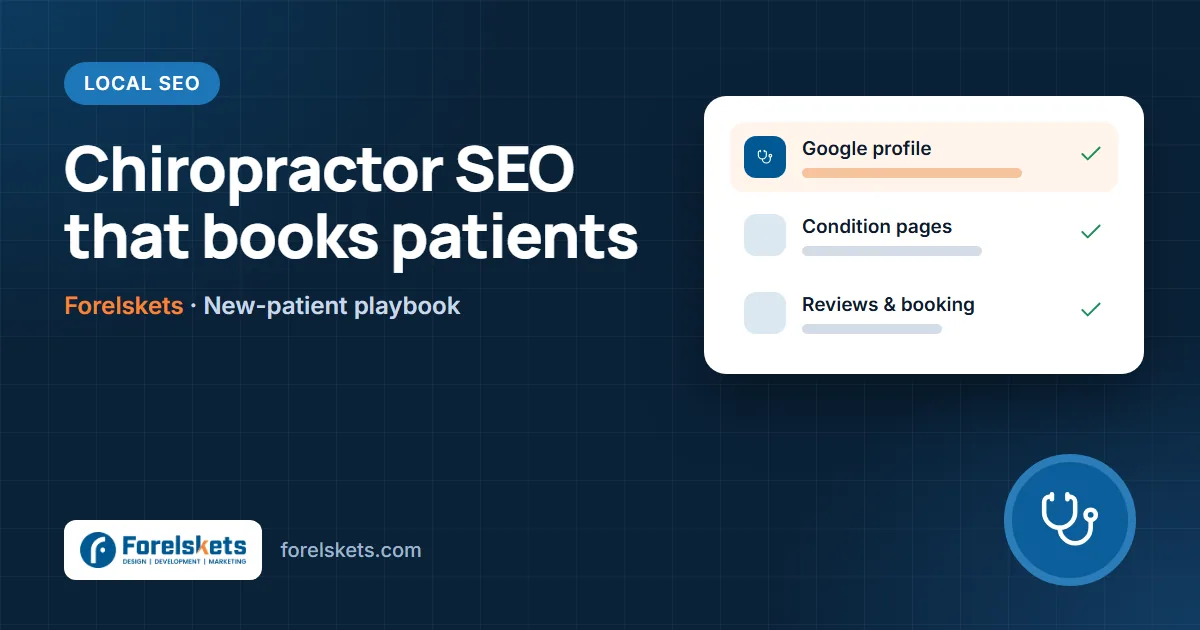
Chiropractor SEO is about appearing when people nearby search for help with back pain, neck pain, sciatica or simply "chiropractor near me" — and making booking easy once they find you. The biggest levers are a complete Google Business Profile, a dedicated page for each condition you treat, a steady flow of genuine reviews, and a fast website with online booking.
Key takeaways
- Choose 'Chiropractor' as your primary category and keep your profile complete.
- Create a page for each condition you treat, reviewed by the treating chiropractor.
- Make booking effortless on mobile and show insurance and pricing information.
- Build a steady review routine without revealing health details in replies.
- Follow healthcare advertising rules in every page and ad.
How patients search for chiropractors
| Search type | Examples | Best page |
|---|---|---|
| Ready to book | chiropractor near me, chiropractor open Saturday | Google Business Profile, homepage, booking page |
| Condition | sciatica treatment, lower back pain chiropractor | Condition pages |
| Specific care | prenatal chiropractor, sports chiropractor | Service pages |
| Cost and insurance | chiropractor cost without insurance, does insurance cover chiropractic | Pricing and insurance page |
| Research | is chiropractic safe, how many sessions for back pain | Helpful articles linking to condition pages |
Step 1: Optimise your Google Business Profile
- Primary category: Chiropractor. Add others only if accurate.
- Accurate hours, including evening and weekend availability.
- Services list: spinal adjustments, sports injury care, prenatal care, massage or rehab if offered.
- Booking link directly to your scheduling system.
- Real photos of your clinic, team and treatment rooms.
- Regular posts about seasonal issues and new-patient information.
Step 2: Build condition and service pages
Each main condition deserves its own page that explains, in plain language:
- Common causes and symptoms.
- How you assess the problem at the first visit.
- Treatment approach and what sessions involve.
- How many visits patients typically need and what affects that.
- When chiropractic care may not be appropriate and you would refer elsewhere.
- A clear way to book.
Written carefully and accurately, these pages rank for specific searches and reassure patients. Have the treating chiropractor review each page and show their name and credentials — expertise matters for health content.
Step 3: Make your new-patient journey easy
- A new-patient page explaining the first visit, what to bring and how long it takes.
- Insurance and pricing information — one of the most common questions.
- Online booking on every page, plus a tap-to-call button on mobile.
- Fast pages — many people search while in pain, on their phones.
Step 4: Earn reviews consistently
Ask patients after a positive visit, send a short link by text or email, and reply to every review. Reviews that mention the condition and your location help both new patients and rankings. Follow privacy rules: never reveal health details in your replies.
Step 5: Local citations and links
- Consistent name, address and phone on major directories and healthcare listings.
- Membership listings in professional associations.
- Links from local gyms, sports clubs, running groups and employers you work with.
- Community involvement: workshops, sponsorships, local health events.
Step 6: Publish helpful content
Good content ideas for chiropractic clinics:
- "Desk posture tips for remote workers."
- "What to expect at your first chiropractic visit."
- "Sciatica: when to see a chiropractor and when to see a doctor."
- "Back pain during pregnancy: safe options."
- "How much does chiropractic care cost in [city]?"
Link each article to the matching condition page and your booking page.
Step 7: Technical basics
- LocalBusiness or MedicalBusiness schema with name, address, phone and hours.
- Mobile-friendly design and fast loading.
- HTTPS and secure forms — avoid collecting health details through plain email forms.
- Clean titles and descriptions for every page.
Our local SEO checklist covers these in more detail, and our free SEO checker can scan your site in a minute.
Advertising rules to keep in mind
Healthcare marketing is regulated in the USA, Canada and Australia. Avoid promising cures or specific outcomes, be careful with testimonials, and follow your licensing board’s advertising rules. If you run Google Ads, check Google’s healthcare and medicines policy.
Measuring results
| Metric | Where to find it |
|---|---|
| Calls, bookings and direction requests | Google Business Profile performance |
| Organic visits and booking conversions | Google Analytics |
| Rankings for condition searches | Search Console and rank tracking |
| New patients by source | Your practice-management system |
Common mistakes
- One generic "services" page instead of condition pages.
- No online booking or hidden phone number on mobile.
- Making medical claims that break advertising rules.
- Ignoring reviews or replying with patient details.
- Not tracking where new patients came from.
Google Ads for chiropractors
Search ads can bring new patients while SEO builds. Focus on high-intent searches such as "chiropractor near me", "sciatica chiropractor" and "chiropractor open Saturday", target a realistic radius around your clinic, and send each ad group to the matching condition page with online booking. Track bookings, not just clicks, and keep ads compliant with healthcare policies. Our guide to SEO vs Google Ads explains how to split the budget.
Turning first visits into ongoing care
- Explain the care plan clearly at the first visit, including expected number of sessions and costs.
- Send appointment reminders by text to reduce no-shows.
- Follow up after the first week to check progress and answer questions.
- Ask for a review once patients report improvement.
- Stay in touch with past patients through helpful seasonal tips, not constant promotions.
Content calendar ideas for a year
| Season | Topics |
|---|---|
| Winter | Snow-shovelling back strain, slips and falls, desk posture during long work weeks |
| Spring | Gardening injuries, returning to running, sports season preparation |
| Summer | Travel and long drives, golf and tennis injuries, carrying children |
| Fall | Back-to-school backpacks, workplace ergonomics, holiday travel |
Multi-clinic practices
If you run several clinics, give each its own Google Business Profile, location page with the team who works there, local reviews and booking link. Report rankings and new patients by clinic, because each location competes in its own neighbourhood.
Website features that help patients choose you
- Photos and short bios of each chiropractor, including qualifications and special interests.
- Clear explanations of techniques used, in plain language.
- Accessibility information: parking, transit, ground-floor access.
- Same-week or same-day appointment availability shown prominently.
- A short video tour or welcome message from the lead chiropractor.
These details answer the practical questions people have when they are in pain and deciding quickly.
Partnerships that bring referrals and links
Local gyms, physiotherapists, massage therapists, running clubs, yoga studios and employers are natural partners. Offer workshops, posture checks or injury-prevention talks; many partners will link to your site or list you as a recommended provider. These relationships bring direct referrals and strengthen your local authority in search at the same time.
How long new-patient growth usually takes
Clinics that complete their profile, publish condition pages and build reviews often see more calls and booking requests from the map pack within a few months. Organic rankings for competitive condition searches in larger cities usually take longer and depend on steady content and local links. Running Google Ads during this period keeps new patients coming while SEO builds. Our guide on how long SEO takes explains the typical timeline in more detail.
Get help growing your clinic
Forelskets helps clinics and healthcare practices in the USA, Canada and Australia win more new patients through SEO, Google Ads and conversion-focused websites. See our SEO services, or explore how an AI receptionist can answer after-hours calls and book appointments.
Frequently asked questions
How long does SEO take for a chiropractic clinic?
Profile and review improvements can lift map-pack visibility within weeks to a few months. Ranking condition and service pages organically usually takes three to six months, depending on local competition.
What pages should a chiropractor website have?
A page for each main condition and treatment (back pain, neck pain, sciatica, headaches, sports injuries, prenatal care), a new-patient page, insurance and pricing information, team bios and a booking page.
Can chiropractors advertise treatment results?
Health advertising is regulated. Avoid guarantees of outcomes and unsupported claims, follow your licensing board’s rules and Google’s healthcare ad policies, and present testimonials responsibly.
Are Google reviews important for chiropractors?
Yes. Review count, rating and recency influence local rankings and are often the deciding factor for new patients comparing clinics.
Should a chiropractor run Google Ads as well as SEO?
Many clinics do. Ads can bring new patients quickly, especially for high-intent searches, while SEO builds a lower-cost source of patients over time.
Do chiropractors need a blog?
A blog helps when it answers real patient questions and links to your condition and booking pages. A few genuinely useful articles each month are better than frequent thin posts.