
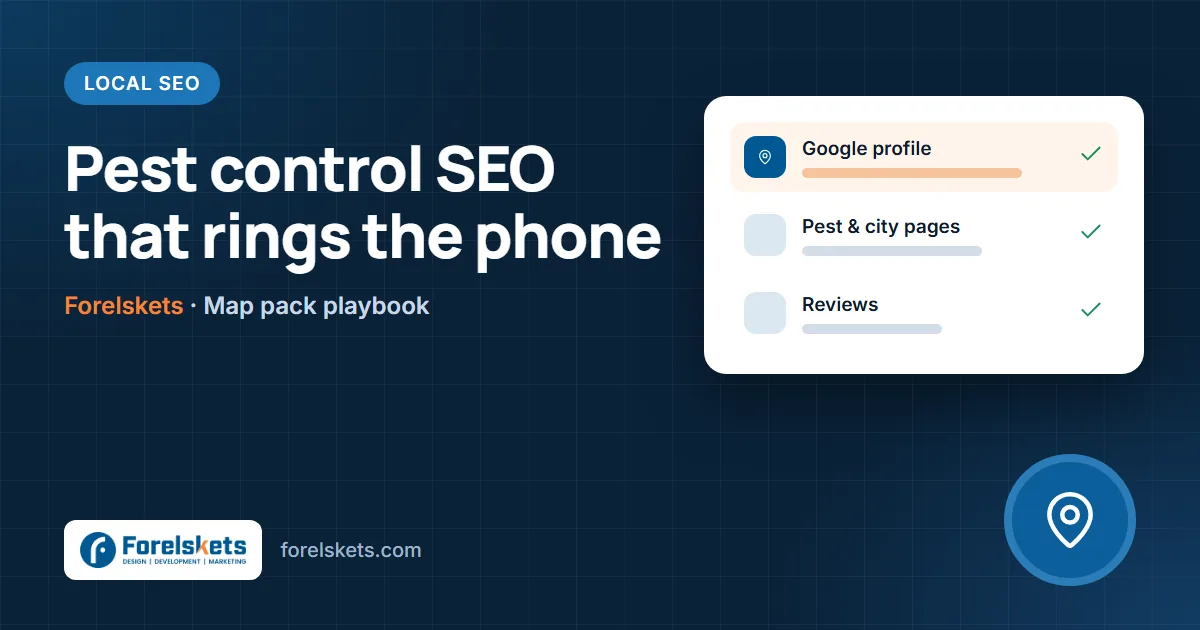
Pest control SEO is about appearing in Google’s map pack and top organic results when someone searches "exterminator near me", "termite inspection" or "bed bug treatment" in your service area. The four biggest levers are a fully optimised Google Business Profile, a page for each pest and service you handle, a steady flow of reviews, and accurate tracking of calls so you know which work pays off.
Here is a step-by-step playbook for pest control companies in the USA, Canada and Australia.
Why SEO matters for pest control companies
Pest problems are urgent and local. People search, compare two or three companies on the map, read a few reviews and call. If you are not in that short list, you rarely get a chance. SEO puts you in front of these high-intent searchers without paying for every click, and the results build month after month.
Step 1: Optimise your Google Business Profile
- Primary category: "Pest control service". Add secondary categories only if accurate (for example "Termite control service").
- Service area: list the cities and ZIP codes you actually serve.
- Services: add every service — general pest, termites, rodents, bed bugs, mosquitoes, wildlife removal, commercial pest control.
- Hours, including emergency availability if you offer it.
- Photos of your team, vehicles and real jobs (no customer details).
- Posts and Q&A to answer common questions and share seasonal tips.
Google explains what affects local ranking in its guide to improving local ranking: relevance, distance and prominence.
Step 2: Build a page for every pest and service
One "Services" page cannot rank for termites, rodents and bed bugs at once. Create a dedicated page for each high-value service:
| Page | Searches it targets | What to include |
|---|---|---|
| Termite control | termite inspection, termite treatment cost | Signs of termites, inspection process, treatment options, warranty |
| Rodent control | rat exterminator, mouse removal | Inspection, exclusion, trapping, follow-up visits |
| Bed bug treatment | bed bug exterminator, bed bug heat treatment | Preparation checklist, treatment types, how many visits |
| General pest control | pest control near me, quarterly pest control | Plans, what is covered, pricing guidance |
| Commercial pest control | restaurant pest control, commercial exterminator | Compliance support, reporting, scheduling |
Answer the questions customers ask on the phone: how soon you can come, how many treatments, whether it is safe for pets and children, and what affects the price.
Step 3: Create city pages carefully
If you serve several towns, location pages can help — but only if each one is genuinely useful. Include jobs completed in that area, pests common there, local reviews, and how quickly you can reach it. Copy-paste city pages with only the town name changed are a common reason local sites struggle.
Step 4: Get more (and better) reviews
- Ask every satisfied customer at the end of the job.
- Follow up with a text message containing your direct review link.
- Reply to every review, positive or negative, professionally.
- Encourage customers to mention the service and town naturally.
Never buy reviews or offer discounts in exchange for them — it breaks Google’s policies and can get reviews removed.
Step 5: Get your technical basics right
- Fast, mobile-friendly pages with a tap-to-call button visible at all times.
- LocalBusiness schema with your name, phone, service area and hours.
- Consistent business name, address and phone number across directories (Yelp, BBB, Angi, Nextdoor, industry associations).
- A clear booking or quote form that works well on phones.
Step 6: Publish seasonal content
Pest searches follow the seasons: mosquitoes and ants in summer, rodents in fall and winter, termite swarms in spring in many regions. Publish helpful guides a few weeks before each peak — "how to tell if you have termites", "keeping mice out this winter" — and link them to your service pages.
Step 7: Combine SEO with Local Services Ads
Where available, Google Local Services Ads show above everything else and charge per lead rather than per click. They are a strong partner to SEO, especially while your organic rankings are still building. Our PPC management team runs LSAs alongside search campaigns for home-service businesses.
Step 8: Track calls and booked jobs
Use call tracking numbers on your website and profile, set up conversions in Google Analytics, and record which leads become paying jobs. Without this, you cannot tell whether SEO, ads or referrals are growing the business.
Keywords pest control customers actually search
Group your keywords by intent so each page has a clear job. Typical patterns:
| Intent | Example searches | Best page |
|---|---|---|
| Urgent, ready to call | exterminator near me, emergency pest control, wasp nest removal today | Service page with click-to-call, Google Business Profile |
| Specific pest | termite treatment, rodent control, bed bug exterminator | Dedicated pest page |
| Price research | termite inspection cost, pest control monthly plan price | Pricing guide or plans page |
| Problem research | signs of termites, how to get rid of mice in walls | Helpful blog guide linking to the service page |
| Commercial | restaurant pest control, warehouse pest management | Commercial services page |
Use real customer language. Many people search "exterminator" rather than "pest management professional", and "mice in attic" rather than "rodent exclusion".
Content ideas that bring local leads
- "Termite season in [your region]: what to look for and when to call."
- "How much does pest control cost in [city]?" with honest ranges and what changes the price.
- "Is pest control safe for pets and kids?" — one of the most common phone questions.
- "Bed bug preparation checklist" — useful for customers and a natural page for links from property managers.
- Case-style posts: "How we cleared a rodent problem in a 40-unit apartment building" (without customer details).
Measuring what SEO brings in
Track these numbers monthly so you can see progress before rankings peak:
- Calls and direction requests from your Google Business Profile.
- Calls and forms from organic website visits (using call tracking and GA4 conversions).
- Map-pack rankings across a grid of locations in your service area.
- Number of new reviews and average rating.
- Booked jobs and revenue by lead source.
Common pest control SEO mistakes
- Choosing the wrong primary category in Google Business Profile.
- Listing a service area far larger than you really cover.
- Thin service pages with a few sentences each.
- Duplicate city pages that only change the town name.
- Not answering the phone quickly — urgent searchers call the next company.
Commercial pest control: a separate opportunity
Commercial contracts — restaurants, food processors, warehouses, property managers, schools and healthcare facilities — bring recurring revenue and are searched differently from residential services. Buyers look for compliance support, documentation and reliability. A strong commercial page should cover:
- Industries you serve and the inspections or audits you help them pass.
- Reporting: service logs, trend reports and documentation for auditors.
- Scheduling outside business hours to avoid disrupting operations.
- Integrated pest management approach and products used.
- A simple way to request a site assessment.
LinkedIn, local business associations and property-management directories are useful places to earn mentions and links for commercial services.
Turning website visitors into booked inspections
Ranking only matters if visitors call. On every service page, make these easy to find within seconds on a phone:
- A large tap-to-call button and your service hours, including same-day or emergency availability.
- Areas you serve and how quickly you can usually arrive.
- Reviews from nearby customers, ideally mentioning the pest you treated.
- Licences, insurance and any safety approach for families and pets.
- A short quote form — name, phone, address, pest — not a long questionnaire.
Answer calls quickly or route them to an answering service during busy periods. A ranking that brings calls you cannot pick up still loses the job.
A 90-day pest control SEO plan
- Month 1: Google Business Profile clean-up, call tracking, technical fixes, review-request routine.
- Month 2: dedicated pages for your top five pests and services, LocalBusiness schema, directory clean-up.
- Month 3: carefully written location pages for your main towns, first seasonal guides, and Local Services Ads if available.
Get help growing your pest control business
Forelskets helps home-service companies win the map pack, rank service pages and track every call. See how we work with home-service businesses, explore our SEO services, or run a quick check with our free SEO checker. After-hours calls can be answered by an AI receptionist so emergencies are never missed.
Frequently asked questions
How long does pest control SEO take?
Google Business Profile improvements and reviews can lift map rankings within weeks to a few months. Ranking service and city pages organically usually takes three to six months, depending on competition.
What is the most important ranking factor for pest control companies?
For local searches, a complete and accurate Google Business Profile, your proximity to the searcher, and the number, recency and quality of reviews are among the most important factors, alongside relevant pages on your website.
Should pest control companies use Google Local Services Ads?
In areas where they are available, Local Services Ads often work well because they appear at the top of results and charge per lead. They complement SEO rather than replace it.
Do I need a page for every city I serve?
Only create city pages when you can add genuinely useful local content, such as jobs completed, common local pests and reviews from that area. Near-identical city pages can hurt rankings.
How do I get more reviews for my pest control business?
Ask at the end of every completed job, send a short text with your review link, make it easy, and reply to every review. Never buy reviews or offer incentives that break Google’s policies.